Digital visibility
Identity records, authentication systems, and databases can decide whether a citizen is recognized in practice. A citizen may remain protected on paper while becoming practically invisible in a broken workflow.
Article 12 defines who counts as "the State" for enforcing fundamental rights. This page studies whether constitutional accountability still reaches the citizen when identity, evidence, welfare, recruitment, examination, banking, policing, and public records move into digital systems.
Article 12 Infected is a constitutional metaphor, not a legal finding. It describes a risk: responsibility can become hard to locate when records, platforms, agencies, and automated systems separate power from answerability.
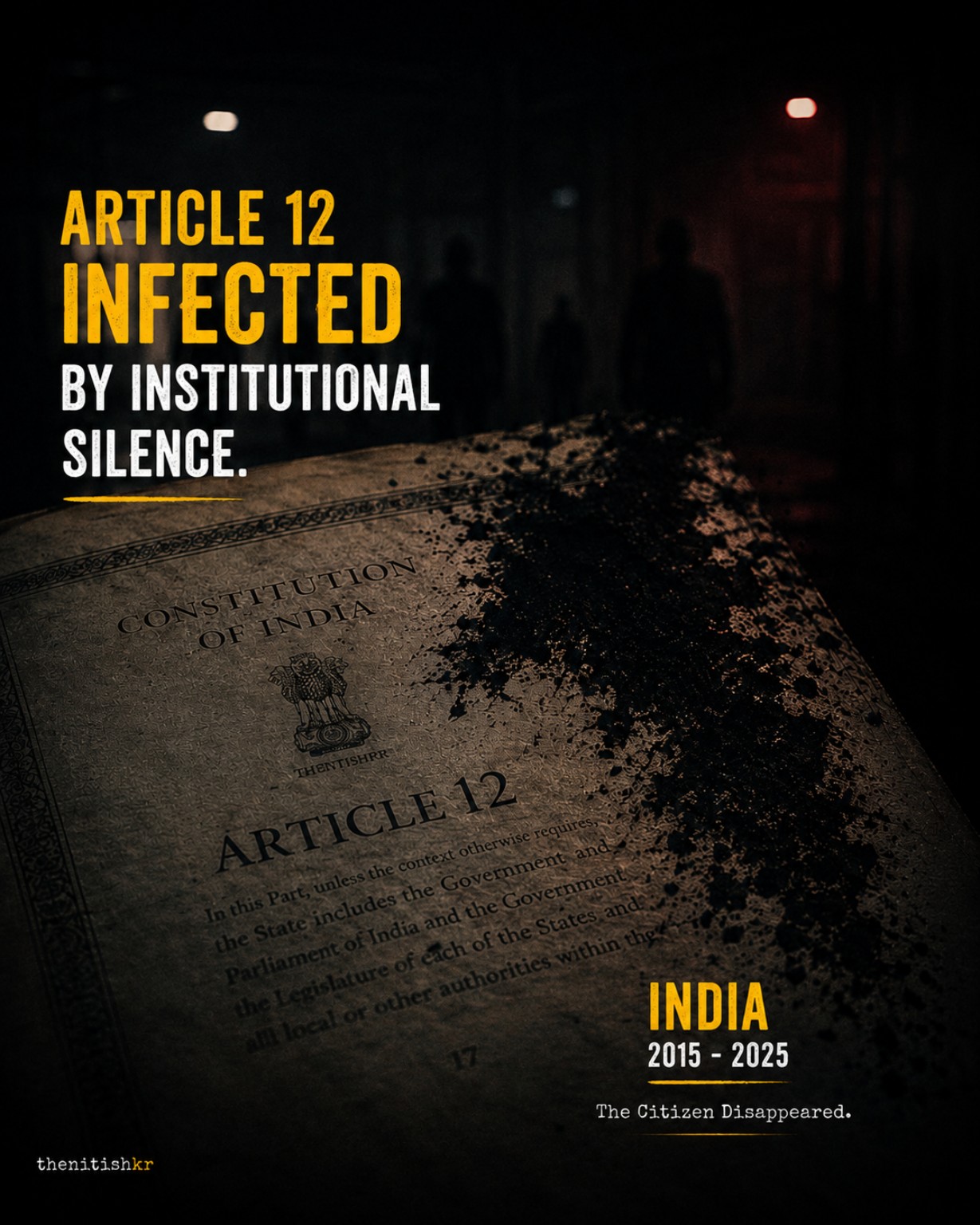
Between 2015 and 2025, India moved identity, education, recruitment, welfare, banking, policing, public records, and citizen services into digital systems. The constitutional question is no longer only whether Article 12 exists in the text. The question is whether accountability flowing from Article 12 reached the citizen when digital systems failed.
Examination controversies, recruitment disputes, cyber fraud, digital identity failures, data-governance gaps, and automated public systems all point toward one constitutional signal: the citizen experiences the impact of power, but responsibility often becomes difficult to locate.
Article 12 Infected is a constitutional metaphor, not a legal finding. It describes a risk: constitutional responsibility can weaken when records, platforms, agencies, contractors, and automated systems separate power from answerability.
Under Article 12, the State includes the Government and Parliament of India, State Governments and Legislatures, and local or other authorities within India or under the control of the Government. In a digital republic, the practical question becomes sharper: when public functions are delivered through portals, databases, automated workflows, vendors, and infrastructure layers, where does constitutional responsibility sit?
Read with the basic-structure discipline associated with Kesavananda Bharati and the Supreme Court's recognition of privacy as a fundamental right in Justice K.S. Puttaswamy v. Union of India (2017), Article 12 becomes the doorway through which digital governance must remain answerable to fundamental rights.
The decade reads as a chain, not as separate incidents. Each layer increased convenience, but also increased dependence on systems whose accountability is often hard for the citizen to see.
Identity records, authentication systems, and databases can decide whether a citizen is recognized in practice. A citizen may remain protected on paper while becoming practically invisible in a broken workflow.
Public examination and recruitment systems affect equality of opportunity, livelihood, dignity, and institutional trust. Their failure is not only administrative; it can become constitutional.
When citizens suffer digital harm, accountability must be traceable across agencies, platforms, intermediaries, payment rails, telecom layers, and evidence channels.
As automated systems influence decisions, Article 12 must answer whether public power remains accountable when exercised through technical architecture.
When a portal rejects a record, a database fails to recognize an identity, or a public process becomes opaque, the citizen experiences the force of governance before any formal classification of responsibility occurs.
Digital governance often separates decision, data, infrastructure, vendor, department, and grievance channel. That fragmentation can leave the citizen without a clear answerable authority.
DISHA connects to this page as a public record architecture: signals are preserved as evidence, evidence becomes memory, and memory makes constitutional accountability readable over time.
The Record is a documentary pointer, not final adjudication. It helps readers follow filings, public correspondence, media references, and research context connected to Article 12 accountability and digital constitutional questions.
References to alleged data misuse, digital harm, or institutional failure should be read with the linked public records and submissions where available. This page uses careful constitutional language and does not present a legal finding.
The theoretical foundation for Article 12 in digital identity, data, and citizen recognition.
ArchitectureThe intelligence architecture for evidence, memory, and accountable understanding.
RecordPublic filings, correspondence, media records, and documentary pointers.
ExplainerA plain constitutional definition for readers who need the legal starting point.
Nitish Kumar (thenitishkr) is an independent researcher and author; he is not the politician of the same name.